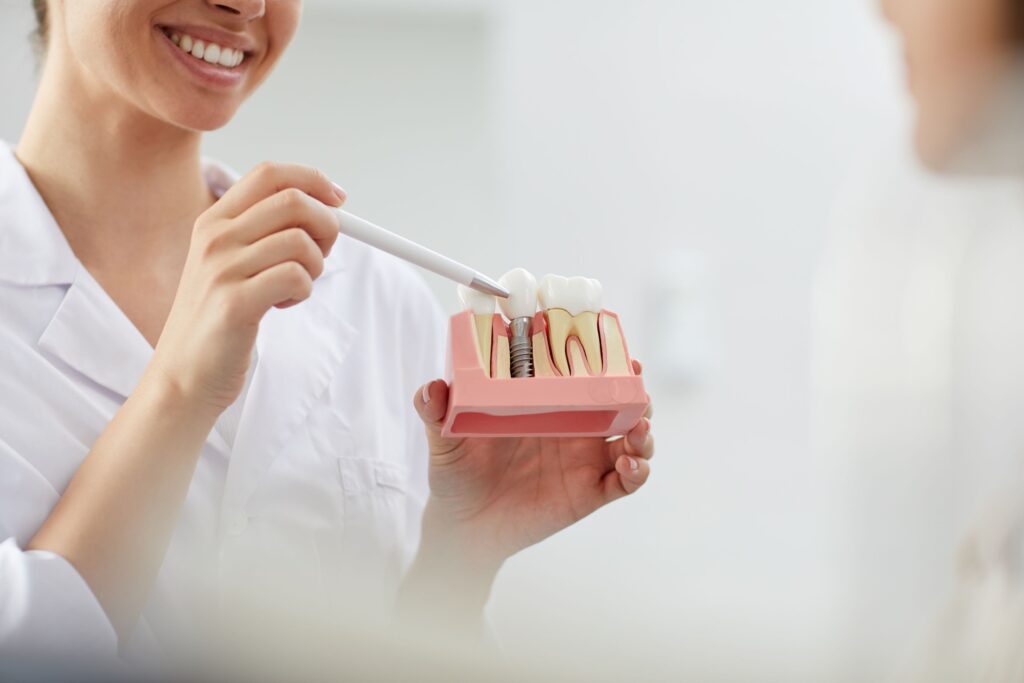
If you’re seeking a lifelike and reliable way to replace one or more missing teeth, you might benefit from dental implants. Many experts consider these restorations the ideal way to rebuild your smile after tooth loss because of their unique placement in your jawbone, which provides more strength and stability than alternative solutions, such as dentures or bridges.
Even better, today, this procedure has an incredibly high success rate of over 90%! But that hasn’t always been the case. Continue reading to learn more about how these replacement teeth evolved over time to benefit you.
What Were the Earliest Dental Implants Made From?
Archeologists have found evidence that ancient people from various cultures around the globe have sought suitable replacement teeth for thousands of years. For example, around 600 A.D. in China, carved bamboo pegs were placed in the jaw to fulfill this purpose. Then, around 1000 B.C., Egyptians used precious metals, elephant ivory, and rare gems like jade.
There is also evidence that some people, like the Etruscans of ancient Italy, used gold and animal bone. Meanwhile, the Mayans likely utilized local materials, such as seashells and gemstones, to restore their smiles.
How Did Dental Implant Materials Progress?
The earliest attempts at making dental implants may have been more cosmetic than functional, because the human body rejects most of the materials used. Centuries passed without much progress in materials until the 1500s to 1800s. As sugar consumption increased, more people developed oral issues that eventually contributed to tooth loss.
At the time, one of the simplest ways to find replacement teeth that wouldn’t be rejected was to collect them from soldiers who had fallen in battle.
When Did Dentists Start Using Titanium for Dental Implants?
Today, these teeth include a support rod made from titanium, a biocompatible metal known for being both incredibly strong and lightweight, which is ideal for oral use. It wasn’t used for bone implants until the 1950s, when Swedish researcher and physician, Dr. Per-Ingvar Brånemark placed the material in the femur of a rabbit. When he went to remove the metal, he discovered it had fused with the bone.
His first attempt to place titanium implants in a human patient was successful in 1965, though his research wasn’t widely accepted until the 1980s.
How Have Contemporary Dental Implants Improved?
These restorations have continued to evolve along with various advancements in dental technology, techniques, and materials. Today, they’re designed to look and feel as lifelike as possible. Once your jaw fuses with the metal in a process called osseointegration, your dentist can place a customized dental crown (or other prosthetic) designed to blend in seamlessly with your smile.
If you’re unsure whether you’re a good candidate for dental implants, scheduling a consultation with your provider is the best way to find out!
About the Practice
At Gold Coast Oral & Maxillofacial Surgery, Center for Dental Implants, patients benefit from two experts eager to help them improve their oral health. Dr. Yusupov and Dr. Yunov have each completed extensive specialty training to offer a range of complex surgical procedures to treat even the most challenging cases. They prioritize patient care and comfort, and offer IV anesthesia to help you get through your procedure successfully. If you are interested in dental implants, you can request an appointment on the website or call (516) 744-6262.